
For much of the relatively young history of entrepreneurship education, the field was often housed within engineering or business faculties.
At Western University, it was no different.

Arriving at the Ivey Business School as the first entrepreneurship hire, the discipline was still in its infancy. Still, it was squarely within the business school, a side hustle to general management that had turned Ivey into the premier business school in the country.
In the early 2000s, we began an entrepreneurship stream for MBA and undergraduate students with a set of courses that provided aspiring founders an academic foundation that included courses on ideation and the process of building new ventures.
Over the years, the selection of courses grew to include social enterprises, finance, sales, managing high growth, as well as more psychological aspects of being an entrepreneur.
Even then, there was a realization that these tools were creating ventures well outside the traditional realms of business. Our alumni were not only building consulting firms, or finance start-ups - they were creating global toy companies, recognizable food and beverage brands, as well as renewable energy and high-tech ventures.
So there was always a curiosity around what could happen if these seeds of entrepreneurship were sown within other disciplines.
What could entrepreneurship education mean for Art Majors, or students in the Humanities?
Some of the biggest wins were already coming from the sciences, from computer science and chemistry to medical science. But could there be more if commercialization frameworks were built into programs and not offered as a side quest to students and researchers?
These questions eventually led to the expansion of the Morrissette Institute of Entrepreneurship Powered by Ivey, to become a campus-wide body that would equip students from all programs with education, mentorship and experiential opportunities to explore and exercise their entrepreneurial aspirations.
From discovery to pitch
Yet moving into other faculties across campus is easier said than done.
There are politics to navigate and history to untangle. There’s competition for student attention, and many disciplines live and die by the numbers.
So it was important to build bridges. We wanted to offer entrepreneurship education and experience, not as a means for students to leave their college or faculty, but to complement them. Entrepreneurship education and experiential learning should be “and” not “or”.
Entrepreneurship will allow students to do what they love - to create careers out of their passions. Their passion for music, philosophy, biology and kinesiology.
Therefore, our first task was to create a series of extra-curricular initiatives designed to meet students where they were.
These included discovery programs for those curious but unsure about entrepreneurship, like a one-day workshop titled The Entrepreneur Experience, which walks students through the process of finding interesting problems worth solving.
This program was coupled with a 4-week experience titled the Startup Challenge that allowed participants to build out those original questions into real, pitch-ready solutions.
One of our largest discovery initiatives was directly connected to GCEC.
Returning from the 2023 conference in Las Vegas, our Directors, Sarah Buck and Deniz Edwards, were inspired by a session that mentioned campus-wide competitions to solve large societal challenges. The seed of this idea developed into The President’s Challenge.
Championed by Western University President Alan Shepard, The Challenge invites students from all faculties to form teams to solve problems in the healthcare space. Coming out of COVID-19, it was something quite relatable for many students.
Importantly, the competition drove cross-disciplinary collaboration by requiring all teams to be represented by at least two Faculties, or Colleges, on campus. Since its launch in 2024, over 1,000 students have participated in the Challenge.
For many, it was their first taste of entrepreneurship.
Today, the institute runs over 250 events a year, including workshops, club events, speaker series, pitch competitions, and a summer incubator - all designed to take students through the start-up journey within the safe confines of the university.
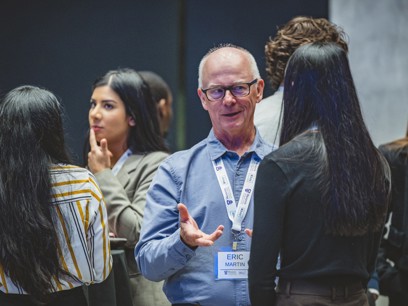
All these programs are supported by more than 400 mentors, or entrepreneurs-in-residence (in person and virtual), who share their time, industry expertise, and real-life experiences. For our students, they make entrepreneurship real and reiterate our motto that it should not be a road travelled alone.
As we continue to expand across campus, it has become vital to grow our base of entrepreneurs-in-residence to serve more students in our various programs.
Academic foundations
Academic programs are important pegs to achieving this “big-tent” ambition.
Having already created a series of successful courses and a certificate program at the Ivey Business School twenty five years ago, we finally introduced a Certificate in Entrepreneurship for students from all programs.
Launched last fall, the certificate includes four courses that introduce concepts like ideation and design-driven innovation, and a capstone course that collates all those learnings as students build a viable start-up with the help of an alumni entrepreneur.
Through the certificate, students from all faculties have the opportunity to take these world-class courses at their own tuition rates.
For our graduate students, we’ve worked closely with Western’s Tech Transfer Office over the past decade, running programs, workshops, and competitions that encourage researchers to discover commercialization opportunities for their research. In the coming year, we’re launching a new program with almost half a million dollars in funding to train graduate students and researchers with entrepreneurial skills.
Building community
In the early years of our expansion, entrepreneurship initiatives were offered at a variety of locations on campus.
It was a travelling roadshow.
But part of university culture is strongly shaped by physical space - and it soon became apparent that entrepreneurship needed a home. Not just in a functional sense to host events, workspaces, and maker spaces, but a place for students and ideas to collide.
Launched in Fall 2024, the Ronald D. Schmeichel Building for Entrepreneurship and Innovation became the largest entrepreneurship-focused building at a Canadian university. Located in the heart of campus - right next to the main library and student centre - the Schmeichel Building was a statement by Western’s leadership that entrepreneurship will be a central pillar of the university's strategy.

This is more than a building. This is a place where tomorrow’s entrepreneurs will cultivate their entrepreneurial spirit, whether they’re in engineering, music, journalism, law, medicine, science, business or the arts. We need to both encourage and back the entrepreneurial culture in Canada, and this new institute is going to play a big role in doing that.
Ronald D. Schmeichel, JD’95.
Today, the building hosts events, houses a cafe that proudly showcases alumni-created products, and two maker spaces equipped with a range of state-of-the-art tools, including CNC machines, 3D printers, water cutters, Cricut machines, embroidery machines and more.
Our maker spaces, like our programs, are open to all students and there are no fees for their use.
Within a Canadian context, this makes our maker spaces extremely unique. All training and workshops are led by student volunteers or Mentor Makers, who themselves represent almost every faculty or college at Western.
The building has also been instrumental in forming a sense of community. Some of this happens naturally in the space, but we have also taken the initiative in training a core group of 36 student leaders representing various faculties.
These student leaders are part of our Founders Program, an award program for second-year students that provides $20,000 of bursaries over three years, exclusive mentorship, and opportunities to lead and shape the student entrepreneurship community.
The Founders are very much our ‘people on the ground.’ They help students find the right programs, mentor young entrepreneurs with their ideas, and represent entrepreneurship at their home faculties. But they also communicate to us what students are looking for and how our programs need to adapt to meet those needs.
Essential, not optional
As we continue to design programs and pathways for our students to explore entrepreneurship, we have been buoyed by the support and encouragement from university leadership, faculty, students and the larger alumni community.
And the timing couldn’t be more critical.
Despite a rich history of entrepreneurs and innovators, Canada has been in a rut for decades.
Today, there are fewer entrepreneurs than there were 20 years ago. In April 2026, the country recorded its sixth consecutive quarter of business closures, outpacing the introduction of new businesses.
This (entrepreneurship) is not just a “nice-to-have” skillset in the modern economy. It’s essential.
President Alan Shepard, Western University
It is a dire warning. And it’s a problem that needs action at all levels of governance.
But it can start at the University.
At Western, we believe we can be that spark - that road to empower, equip and embolden our students to see what’s possible and work towards building those new realities.
When students are trusted early, supported meaningfully, and given space to build something real, they don’t just learn differently – they begin to move differently. They take initiative, they create, and they carry that mindset into whatever fields they enter.
Sydney Burns, Philosophy Major and Co-founder of Stable Insights